One-Way Masking for Travelers: When No One Else Is Masking

You might be wondering about one-way masking. Should you still wear a mask when no one else is wearing one?
According to recent reports, the incidence of COVID-19 cases is high across the U.S.
Moreover, travel has returned to pre-pandemic levels, with more people traveling both domestically and internationally.
At the same time, mask mandates have fallen by the wayside since the height of the pandemic, and most people have given up on the idea of masking close to home or at their travel destinations.
In August 2024, Nassau County, NY, even instituted a face mask ban, which may be the first in the nation.
The Mask Transparency Act makes it a crime to wear a mask or face covering to hide one’s identity. The controversial law purportedly was created to combat antisemitism after masked men took over a subway car in New York City, hurling threatening antisemitic comments at riders.
Due to the almost total disappearance of governmental mask mandates, very few people wear them, and those who choose to stand out in a crowd.
Given these circumstances, travelers need to consider (and perhaps reassess) their approach to masking to determine what feels “right” for them.
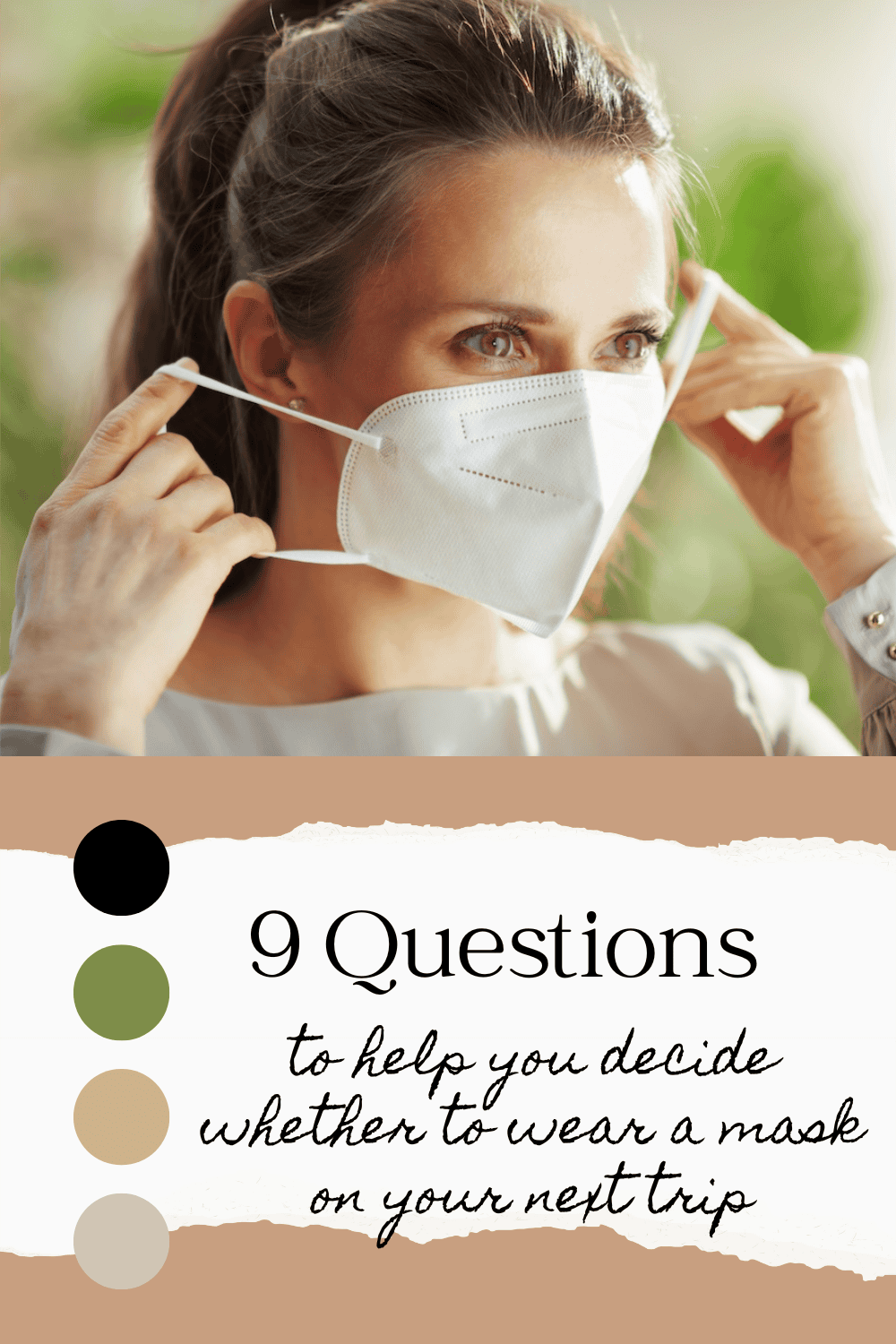
Whether to wear a face mask (or not) when traveling is largely up to each individual. Here are nine questions to ask yourself to help you think through your personal mask policy.
To Mask or Not To Mask: 9 Questions To Help You Decide
1- Where am I going?
Location, location, location. The prevalence of COVID-19 varies from place to place. Infection rates are fluid and may change between when you plan your trip and when you take it.

Of course, traveling to places where the prevalence of the infection is higher tends to be riskier and might make you more inclined to mask up. Check news reports at your destination to see if they offer some information on current rates.
According to the U.S. Centers for Disease Control (CDC), wearing a mask helps lower the risk of transmitting and catching respiratory viruses, including COVID-19.
2- How will I get there?
Your mode of transportation also affects your risk. While the U.S. Transportation Security Administration (TSA) eliminated mask mandates in April 2022, the CDC recommends that everyone ages two and older wear a well-fitting mask in indoor public transportation conveyances (such as airplanes, trains, etc.) and at transportation hubs (like airports and bus and train stations).
The CDC notes, “Wearing a mask in indoor public transportation settings will provide protection for the individual and the community.”
Note: At airport security checkpoints, TSA will likely ask you to remove your mask to verify your identity.

To determine whether or not to mask, someone needs to guesstimate the density of the transportation experience and the adequacy of ventilation, among other factors.
Even though Uber dropped its mask mandate in September 2022, we still wear masks when we take an Uber or Lyft.
3- What types of venues will I be visiting?
While some museums and attractions still have timed entry and spacing policies, most have dropped them. To know what to expect, checking the venue’s website close to your visit is always prudent in determining what policies are in effect.
Experts agree it’s good to don a mask in crowded indoor venues or when waiting in queues where you will be in close contact with other people. You might even consider masking up if you are attending an outdoor concert or sporting event where you’ll be in close contact with one or more individuals over a prolonged time.

4- How great is my personal risk?
Even if fully vaccinated, certain factors place some people at greater risk than others. These include:
- Being over the age of 50;
- Having an underlying health condition or disease that might compromise immunity, or being pregnant; and,
- Of course, not being fully vaccinated.
According to the CDC, the risk of severe illness from COVID-19 increases for people in their 50s and then increases for those in their 60s, 70s, and 80s, with people over the age of 85 the most likely to get very sick.
Even among the vaccinated, the CDC reported that over 75% of COVID-related deaths occurred in people with at least four medical risk factors..
5- How concerned am I about protecting the health of others?
When people travel, they often travel with companions. Additionally, they come in contact with other travelers and locals who may not be fully vaccinated or at high risk for infection.
For example, if you are traveling with an older grandparent or immunocompromised child, you’ll want to mask up to help protect the people you are traveling with. Others opt to keep their masks on as an additional precaution to stop the spread of infection among the general population.

6- How much risk am I able to tolerate?
People differ in terms of how much risk is acceptable to them. They range from highly risk-averse people who will take every precaution possible to avoid the virus to those who throw caution to the wind and have forgotten about COVID-19.
With more people vaccinated, it is understandable that many stopped using masks because they wanted to move past all the precautions or reminders associated with the pandemic. Others see them as an easy way to reduce risk, one that is only mildly annoying or inconvenient.
7- Are masks really worth wearing?
Several studies have shown that although not 100% effective, masks work.
A study in Emerging Infectious Diseases (reported 2/22 by JAMA) found that after exposure to an infected individual, an uninfected person’s risk of infection was cut in half if both people were masked. (The publication notes several drawbacks to the research, one of them being that vaccination rates have risen dramatically since the data was collected.)
Another study of mask effectiveness in California (2/22) recently reported by the CDC found that “consistent use of a face mask or respirator in indoor public settings was associated with lower odds of a positive SARS-CoV-2 test result… and use of respirators with higher filtration capacity was associated with the most protection, compared with no mask use.”

The importance of using high-quality, well-fitting respirator masks, such as N95 or KN95 masks, cannot be overemphasized. These masks are far more effective in blocking large respiratory droplets and airborne particles than surgical masks or cloth face coverings.
8- What about one-way masking? Does it work?
Yes, even one-way masking works (wearing a mask even if others around you aren’t is another protective measure travelers can take, said former FDA Commissioner Dr. Scott Gottlieb at a March 3, 2022, virtual event sponsored by Norwegian Cruise Line.
“One-way masking provides some protection while traveling as long the masks are worn properly,” says travel medicine physician Kunjana Mavunda, M.D., and lead physician at Miami-based International Travel Clinic.
“I suggest that my patients wear a mask in crowded areas at the airport, such as when going through security, while waiting to board the plane, and on the plane, at least until everyone is seated and settled,” she says.
“Also, they may be beneficial to wear in congested areas where people are being noisy because that’s when their oropharyngeal secretions get aerosolized,” says Dr. Mavunda. “Immunosuppressed and fragile people should wear well-fitting layered masks at all times, at least for now.”

In a lively discussion on NPR’s All Things Considered, when NPR health reporter Will Stone was asked about the effectiveness of one-way masking, he said, “It really depends on things like how crowded it is, how long you spend indoors, the ventilation. One modeling study from Germany found you’d have about a 20% risk of getting infected after an hour. And this is assuming you have on an N95 and you’re near someone who’s unmasked and contagious.”
But Stone emphasized that these are all rough estimates. “The bottom line is a mask can help you, but it can’t totally eliminate risk,” he concluded.
9-Am I feeling peer pressure to unmask?
At one point during the pandemic, almost everyone on the streets of large cities wore masks. That number dwindled, and mask-wearers here and abroad may now feel self-conscious and awkward wearing one.
There is also the peril of becoming a target of the culture wars that have divided the nation (and the world). Mask mandates and mask-wearing have become a divisive issue, and mask-wearers may find themselves taunted or scorned by anti-maskers.
Peer pressure is powerful. In subtle and not-too-subtle ways, someone can be easily influenced to feel awkward and uncomfortable—even among friends, relatives, or co-workers—if they are the only ones wearing a mask among the maskless. In those instances, one tends to let down one’s guard when everyone else is doing the same.
The bottom line: Should I still wear a mask on my next trip?
“My wife and I have both managed to avoid getting COVID over the past two years, despite frequent trips that involved plane travel,” says Tim Leffel, editor of PerceptiveTravel.com and author of The World’s Cheapest Destinations.
“I chalk that success up to vaccinations and diligent mask-wearing, so I’ll keep donning one on a plane and in airports until the risk of infection from anti-science dolts around me has fully subsided,” says Leffel. “It’s a minor inconvenience compared to even a mild case of Covid that puts you out of commission for days.”
In The Wall Street Journal, reporter Allison Pohle interviewed Dr. Henry Wu, an associate professor of infectious diseases at the Emory University School of Medicine and director of the Emory TravelWell Center, who said that the onus of responsibility for COVID safety has shifted from governments to individuals. But he went on to say: “…fewer requirements doesn’t mean travelers should abandon all precautions.”
Mask-wearing has become a personal choice, hopefully informed by the best available knowledge. One-way mask-wearing isn’t a black-and-white issue, either. For example, a traveler may decide to wear a mask in certain situations and not others.
The virus and its variants are unpredictable and can spread quickly, and we are still learning about its treatment and prevention (especially long-term COVID). Whatever personal mask policy someone adopts, it’s always wise to carry several high-quality masks in one’s carry-on bag, just in case.
Save to Pinterest!!