Kermode Bear: Into the Lair of the Great Spirit Bear
The white-furred Kermode bear is a legendary creature that resides in Canada’s West Coast Great Bear Rainforest. Contributor James Ross* takes readers on a fascinating tugboat expedition cruise in British Columbia with Maple Leaf Adventues.
Deep within British Columbia’s Great Bear Rainforest lives a rare white bear known as the Kermode. To the Kitasoo Xai’xais Nation, in whose traditional territory these bears reside, this rare creature is recognized as a Spirit Bear. Fewer than 150 are thought to remain. I must admit, the idea of seeing one of these fabled animals during my visit here felt improbable, almost mythical.
I was here on an expedition cruise, a tugboat adventure into the raw beauty and isolation of one of the planet’s most dynamic ecosystems, and, at 6.4 million hectares, the Great Bear Rainforest is the world’s largest temperate rainforest. This is a land of massive fjords, islands, and great river estuaries. Our journey in search of the elusive bear would lead us far from the familiar.
Kitimat was our rendezvous point, situated at the head of one of the longest inlets on the British Columbia coast. A welcoming crew greeted us at the top of the gangway, commandeered our luggage, and invited us to board. The MV Swell would become our cozy and charming sanctuary for the 8-day voyage, in stark contrast to the untamed wilderness we were about to experience.
The Spirit Bear
On the third day of our journey, we left the ship by small tender and slipped into a remote estuary, the water dark and glassy beneath a low coastal sky. Waiting on shore was our Kitasoo Xai’xais guide, Marvin Robinson, whose quiet presence seemed attuned to the rhythms of this landscape. With him, we followed a narrow path onto Gribbell Island, where the forest pressed close and the air held the pungent odour of rotting salmon.
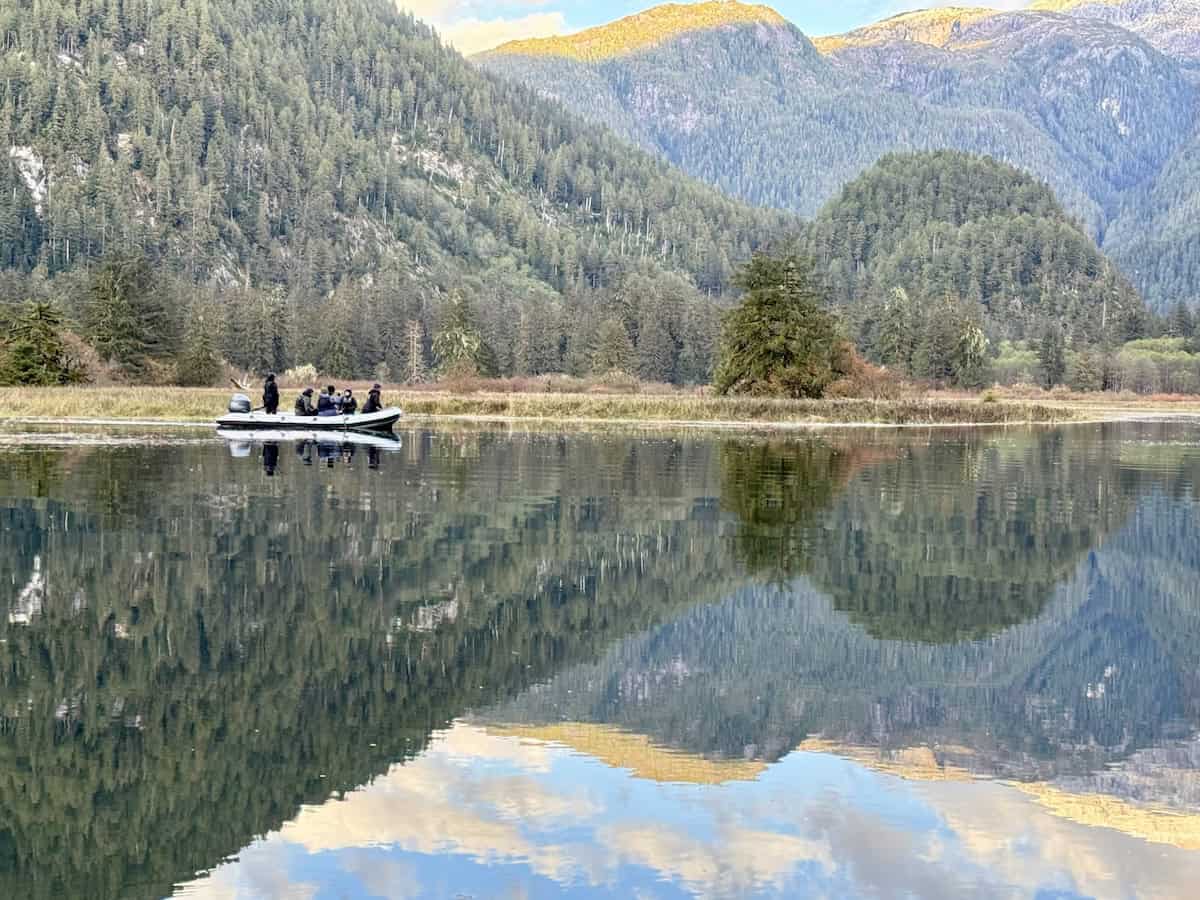
After a mile trek, the trail descended to Riordan Creek, a boulder-strewn river with salmon carcasses tossed here and there along its shores. There were viewing platforms built on the banks. We settled in the chairs to wait in reverent silence.
The river moved steadily past us, as the last of the spawning salmon struggled upstream in a seasonal ritual that draws bears from the surrounding forest. No talking, no sudden movement— just patience, and the quiet hope that somewhere beyond the curtain of trees, something rare and extraordinary might step into view.
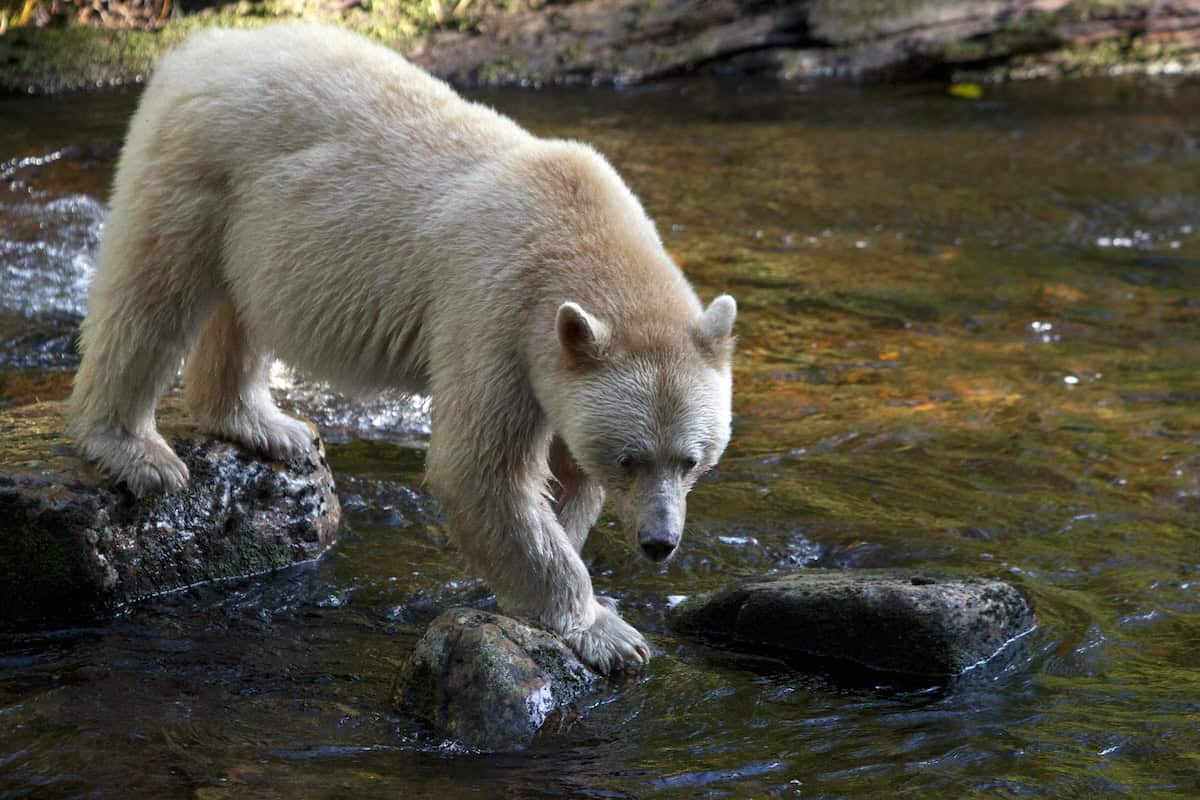
Then, almost like an apparition, out of the veil of trees on the far bank just downstream from us, a bear suddenly appeared, its creamy fur luminous against the dark shoreline.
The Kermode bear paddled across the river stones with a gentleness that seemed unreal for something so powerful. It fished with deliberate grace, as though performing an old ceremony. The bear lifted its head, a salmon in its jaws and water streaming from its muzzle, and glanced in our direction. She didn’t look startled, just aware, and perhaps used to groups of people sitting on this platform. Then the sow resumed fishing, unhurried and unbothered.
I walked upstream to where Marvin sat quietly watching, to ask him some questions about the Spirit Bear. Ursus Kermodei is, in fact, a black bear with a recessive gene that produces a white coat in one bear out of ten. While scientists find them a genetic curiosity warranting protection, Robinson tells me his people see Spirit Bears as a reminder of a time when the world was entombed in snow—or even in more personal terms, as ancestors who have returned to walk the Earth again.
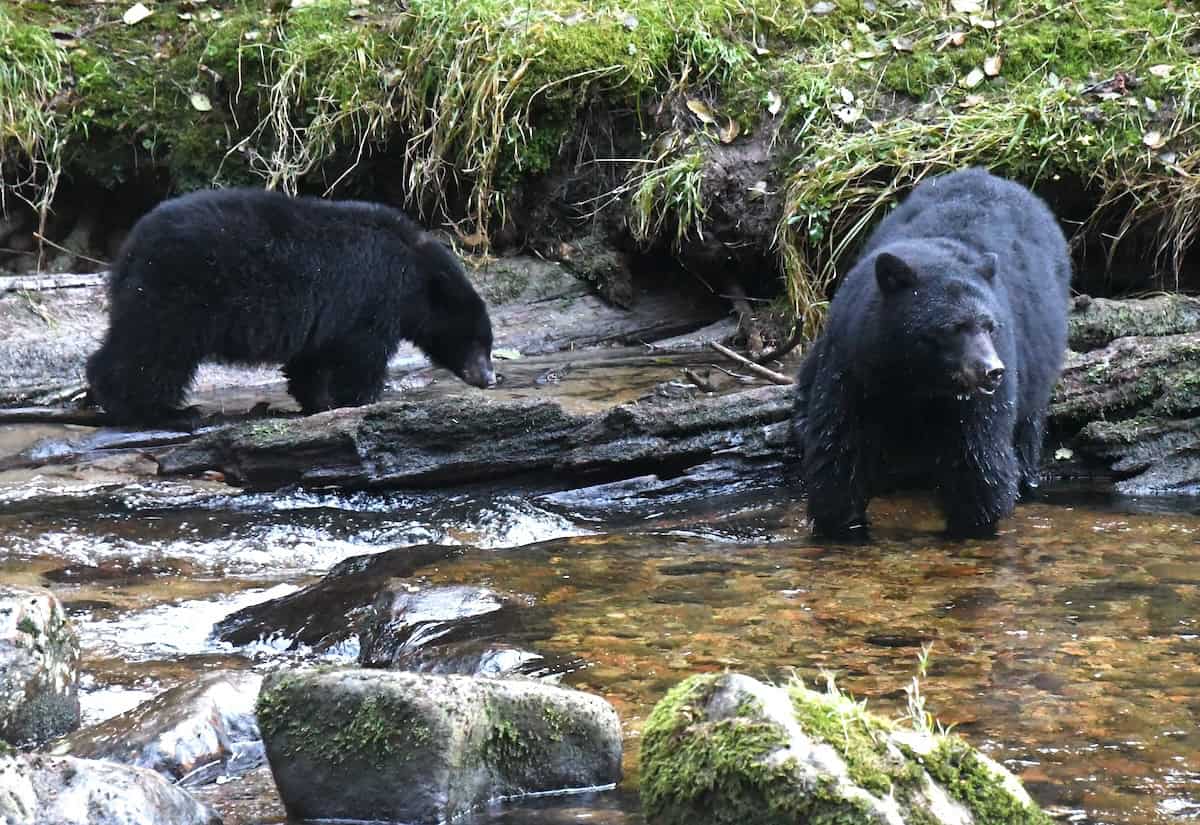
A movement upstream caught my attention, and I looked up to see a black bear sow and cub approaching slowly along the bank. “Just stay calm and don’t panic,” was the guide’s advice. So, I watched in wonder as the bears wandered past a mere 10 feet from where I stood, concentrating more on the salmon than on me. It was a thrilling and exhilarating experience.
Our Tugboat Swell
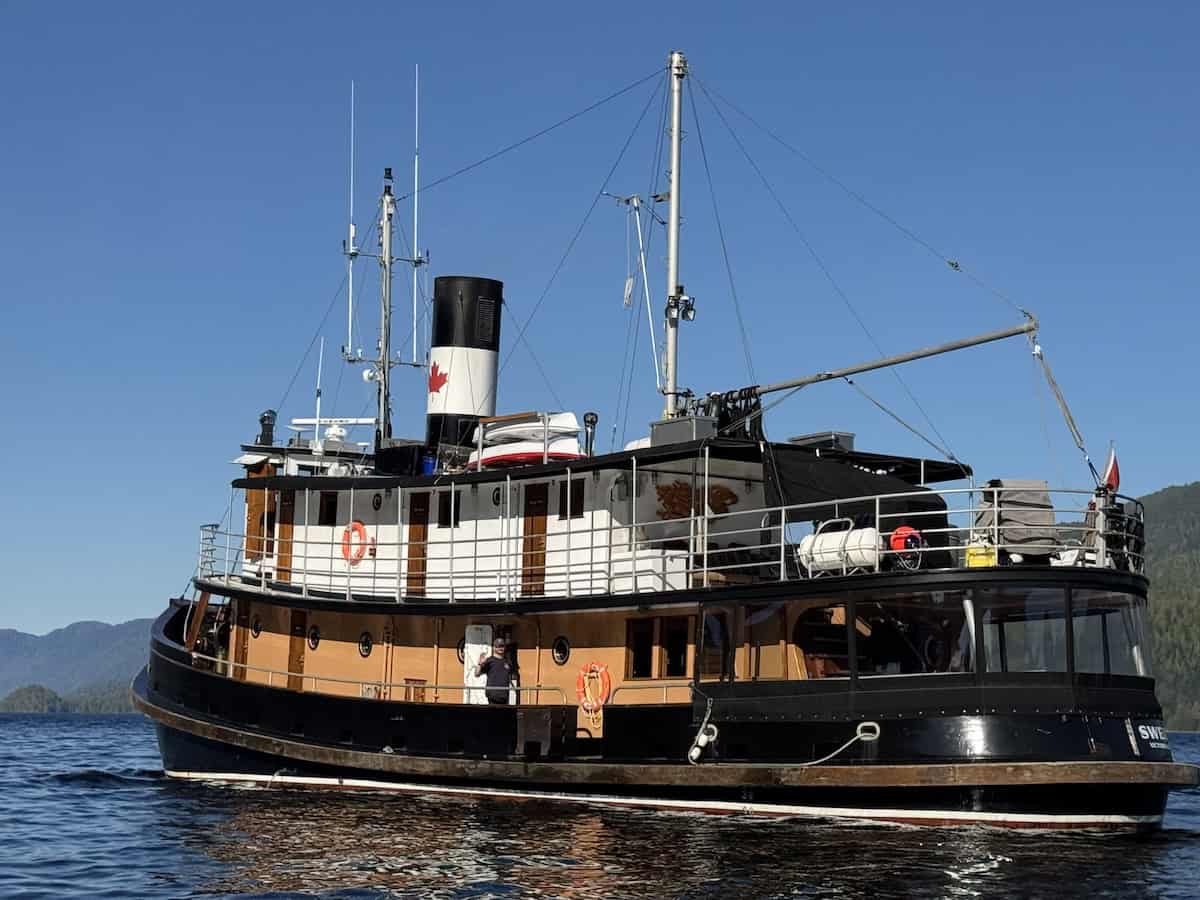
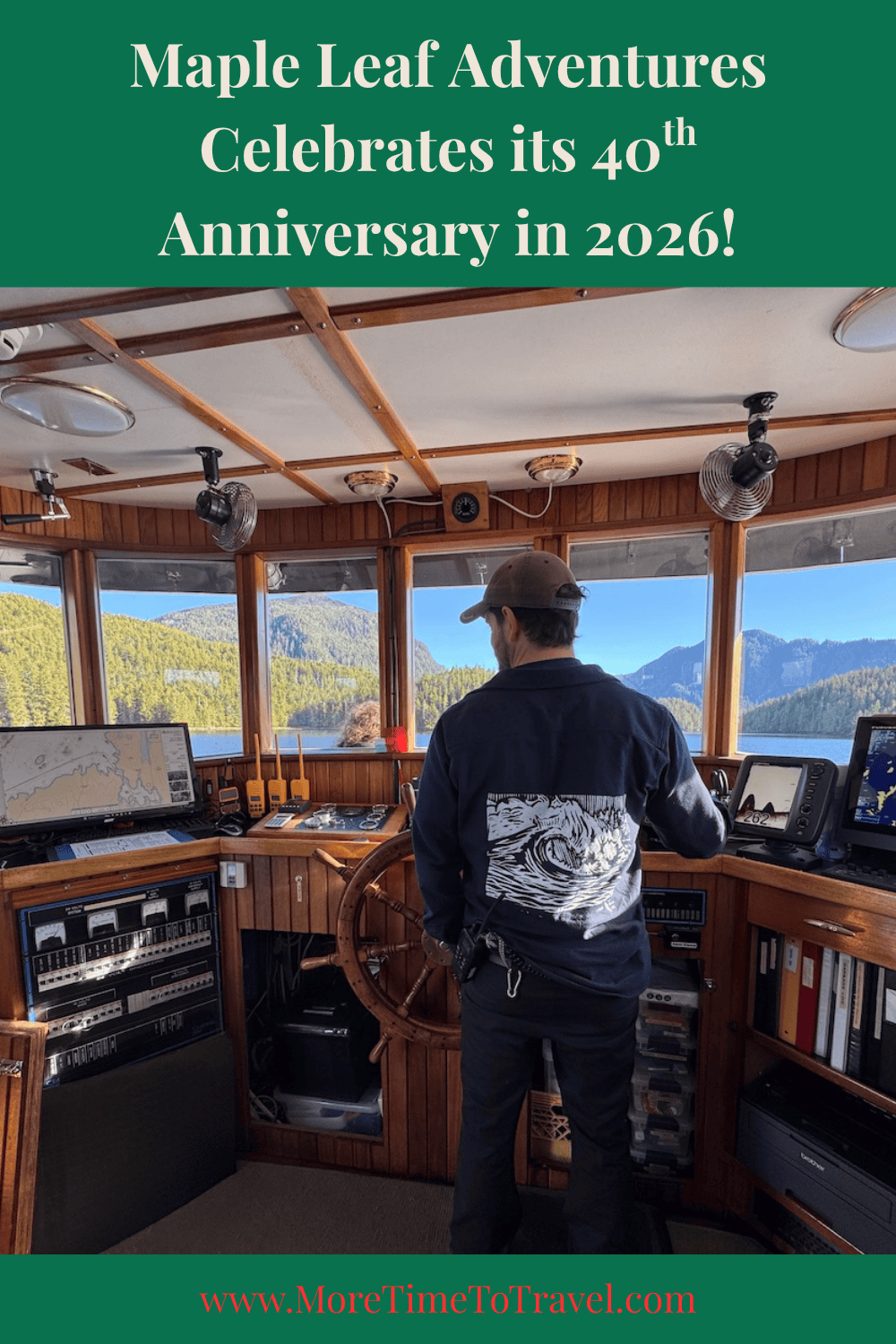
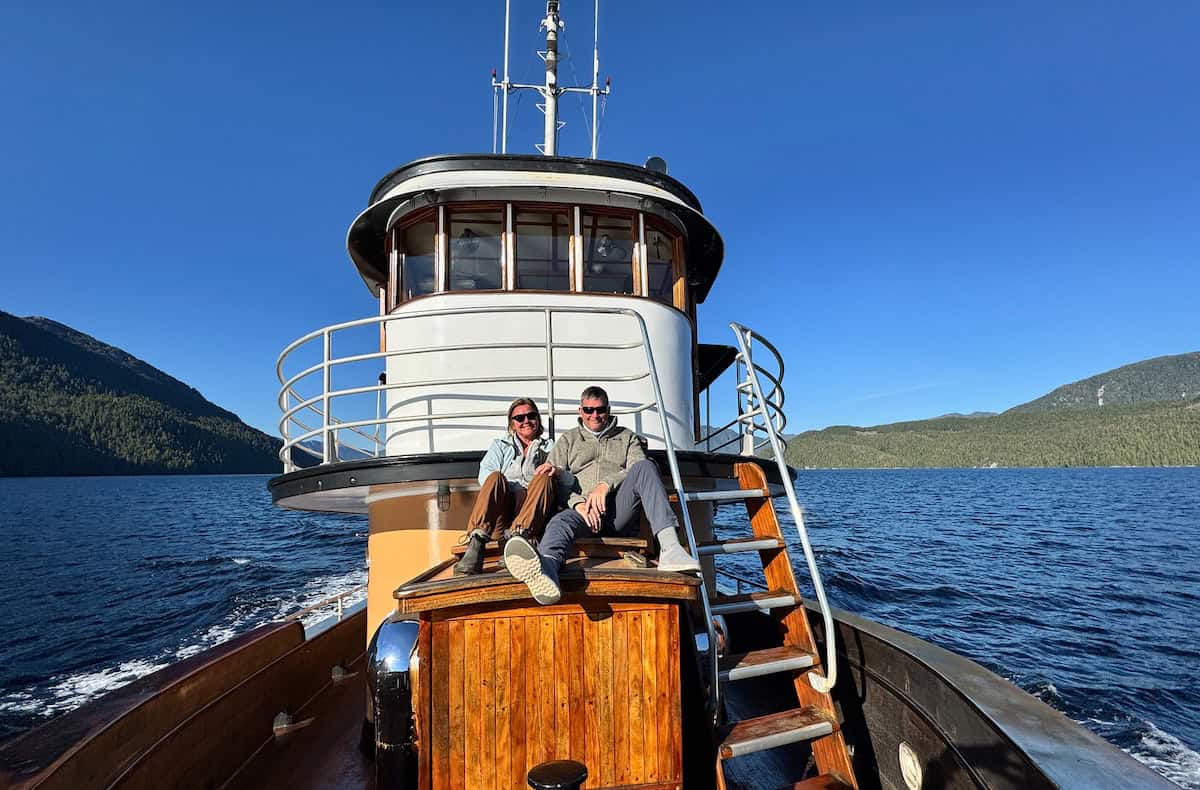
Our home throughout this journey was Swell, an 88-foot vessel with a history as rich as the coastline itself. Built in Vancouver, it had spent more than nine decades serving remote coastal communities before being thoughtfully restored and reimagined as an intimate floating hotel. The Swell became part of Maple Leaf Adventures in 2014, joining a two-masted schooner called Maple Leaf and a catamaran called Cascadia, a trio of vessels that offer various adventure and educational itineraries up and down the BC coast as far north as Alaska.
With just six cabins accommodating twelve guests, life aboard our tugboat felt both comfortable and deeply connected to the surroundings. A crew of five guided us through these waters, their knowledge shaping each day, among them a whale scientist, Valeria, whose insights brought new depth to every sighting.
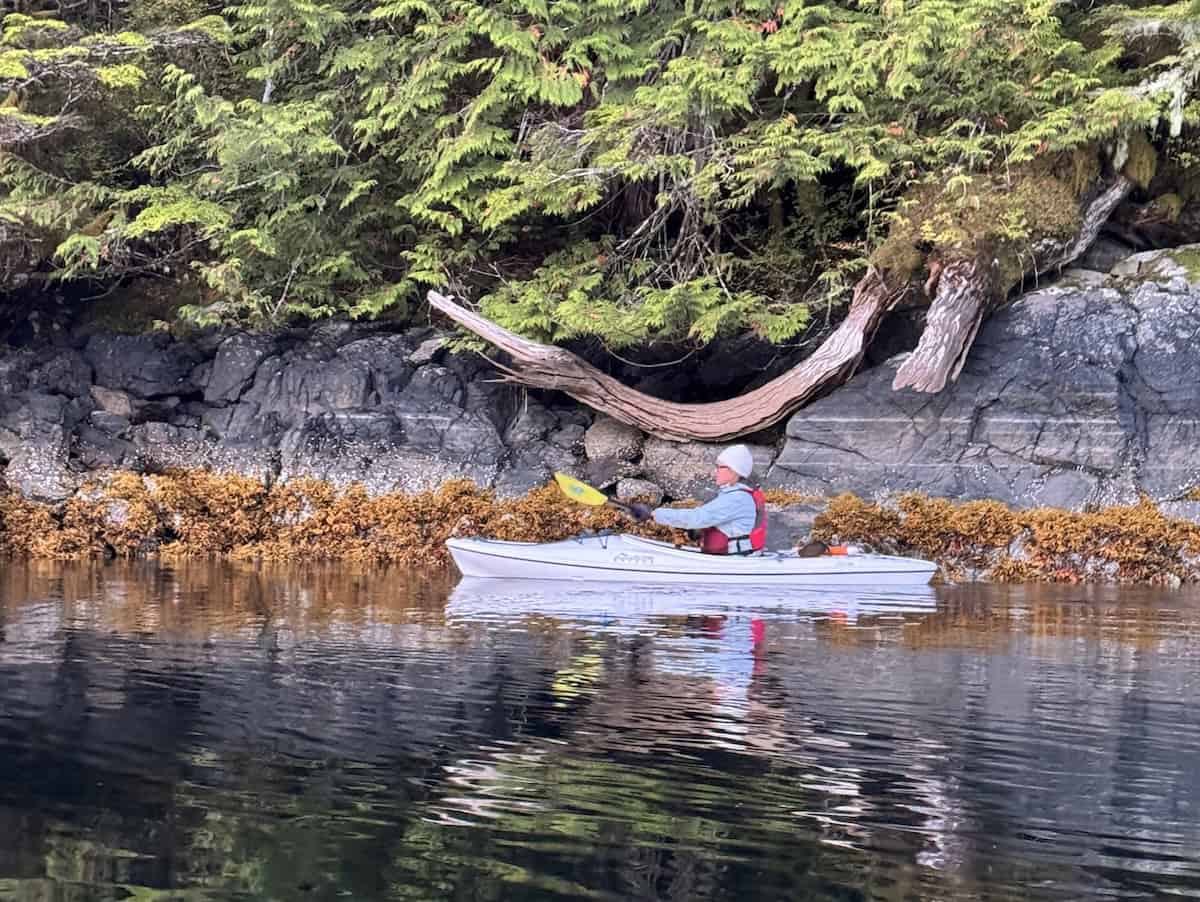
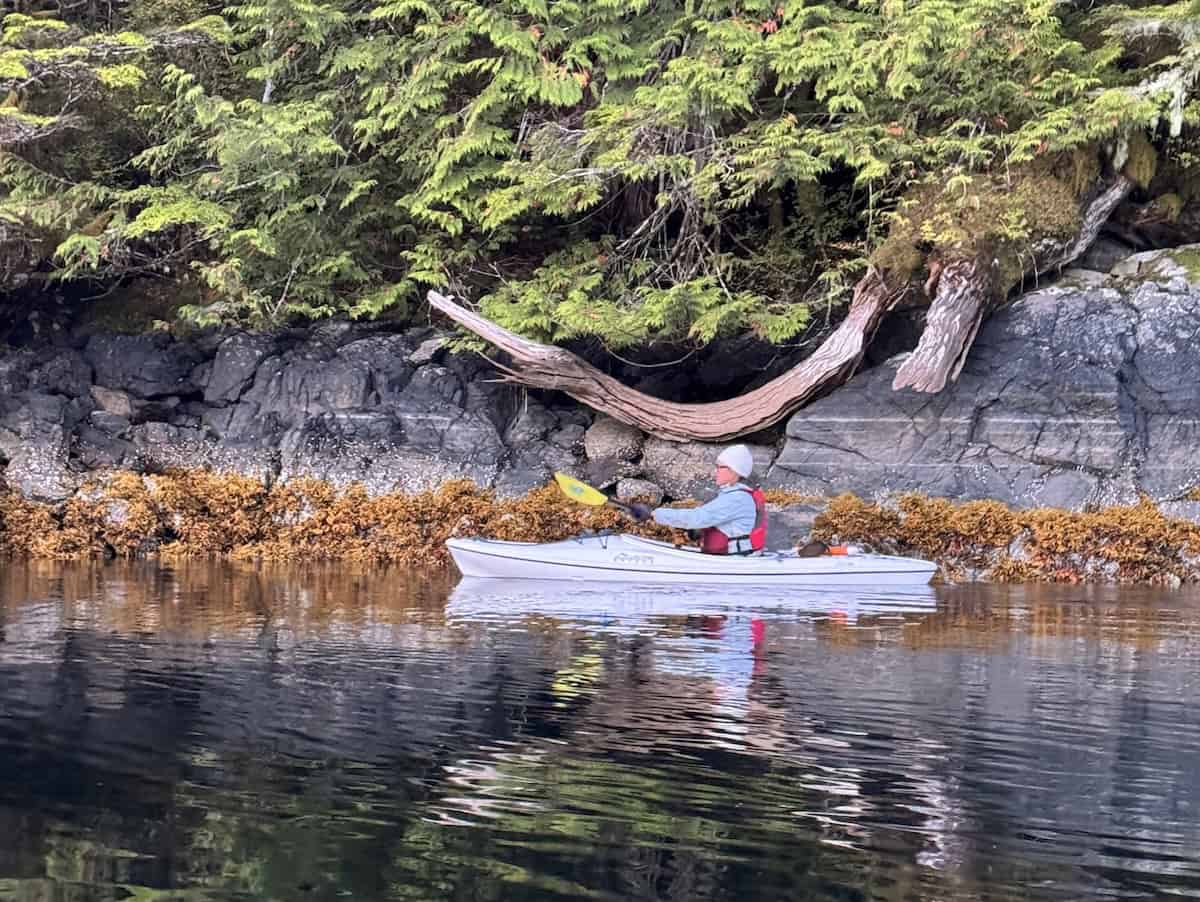
Gourmet meals greeted us in the galley courtesy of our South African chef, Nic. At night, we would anchor in a peaceful, sheltered bay and sit in the ship’s hot tub underneath an amazing canopy of stars. Then, at first light, we would take the ship’s kayaks out to explore the rugged shoreline.
Much More than Forest Spirits
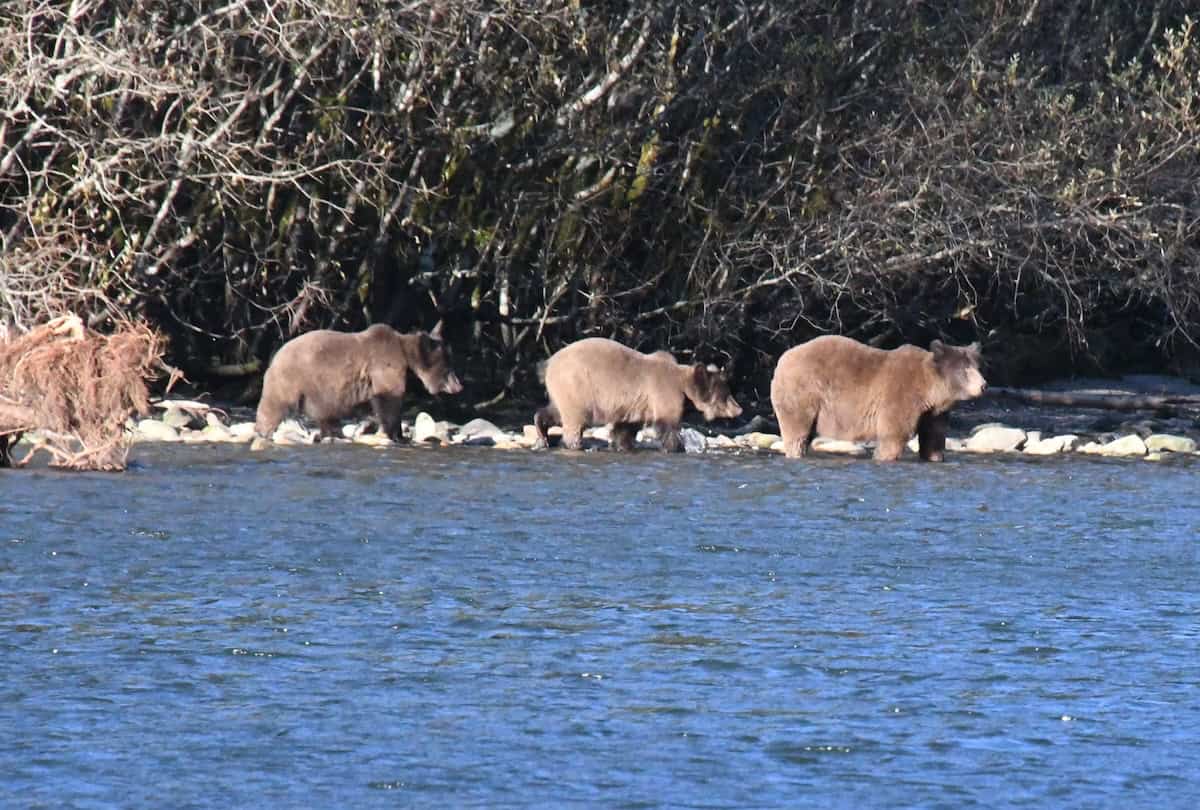
Beyond our search for the Spirit Bear, the rainforest revealed itself as a place of constant motion and life. We left the tugboat in the Zodiac tenders to slowly make our way up the river estuaries. Here, we encountered grizzlies combing the shoreline and feeding on the last of the salmon in the creeks. A sow and two cubs watched us from a gravel sandbar before jumping into the river to swim across.
We witnessed river otters slipping through the shallows, and seals and sea lions hauled out on rocks or vanishing with a splash at our approach. Back aboard Swell, pods of dolphins surfed our bow waves, while seabirds wheeled overhead, their cries carried on the salt air; bald eagles, osprey, coastal northern goshawks, harlequin ducks, American dippers, marbled murrelets, common murres, rhinoceros auklets, black oystercatchers, black turnstones, shearwaters, and cormorants.
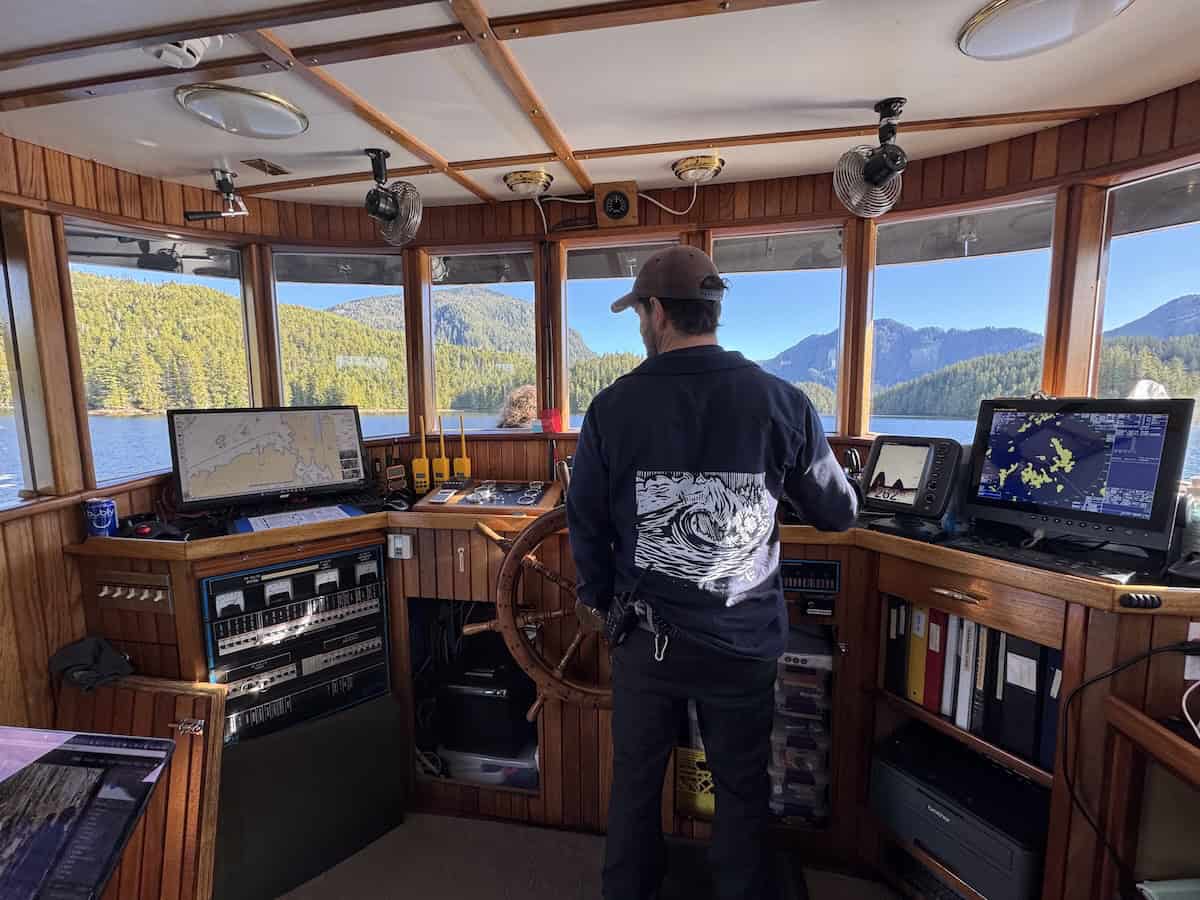
We cruised quietly along Whale Channel when a faint hiss broke the silence. Then we saw it, the arc of a black back, a fin slicing through the calm sea. An orca paralleled our course. A second fin appeared. Then a calf breached, playful as a child splashing in a lake. Soon, a family group surrounded our tug. Even Captain Brian stepped out of the wheelhouse and leaned on the rail with a look that suggested that, though he had seen this a hundred times before, it never lost its magic.
We followed the pod of four or five orcas as they moved with a purpose along the channel. At Ashdown Island, we saw a huge colony of Steller sea lions basking in the sun, so we jumped into the tenders for a closer look. While the adults barked loudly from their perch on the rocky island knoll, younger sea lions dove into the surf to frolic with their friends. Then we saw the orcas approaching, stealthfully splitting up and surrounding the island. It was nature at its rawest and most beautiful, but it was hard to know who to cheer for.
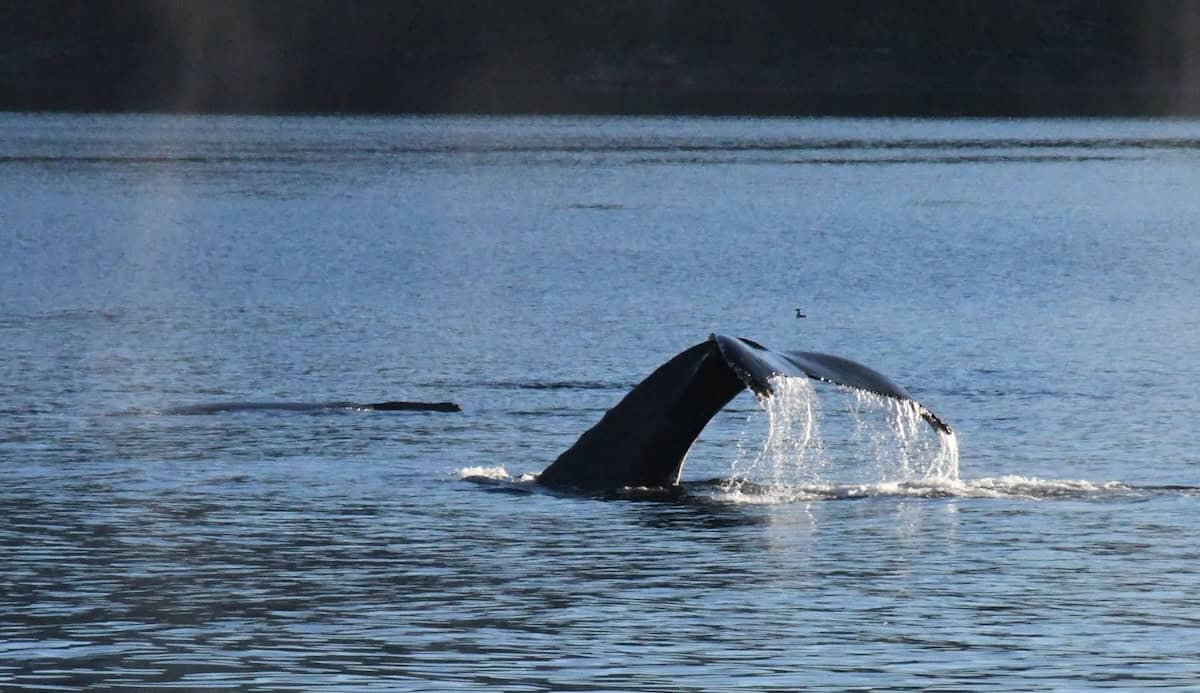
I loved sitting at the bow when the call came from the bridge: “Whales! Off the port side!” The waterways of the Great Bear Rainforest are rich feeding grounds for humpback whales. We saw frequent spouts from blowholes hanging in the chilly air as the giants surfaced, dorsal fins rolling in slow arcs, tail flukes rising before deep dives, and, occasionally, the thrill of a full breach. Humpback whales worked together in intricate bubble-net feeding displays just beyond the boat. At other times, minke and fin whales surfaced more quietly, powerful reminders of the vast world moving beneath us. The crew called it “whale soup.”
Protecting the Great Bear Rainforest
Organizations like Maple Leaf Adventures have made it their mission to bring small groups of travelers into this remote corner of coastal British Columbia, not just as spectators, but as witnesses. As co-owner Kevin Smith puts it, “People protect what they love, and you can’t love something until you’ve experienced it.” This year, as they celebrate their 40th anniversary, the company continues to follow that philosophy, offering intimate journeys that foster a deeper understanding of this extraordinary ecosystem.
It’s a place that very nearly disappeared. Not long ago, the Great Bear Rainforest stood on the brink, threatened by industrial logging that would have forever altered its ancient landscape. Its survival came through an unlikely alliance, a handshake agreement between conservationists, Indigenous communities, and the timber industry that protected vast stretches of this coastal wilderness while allowing limited, sustainable use. It remains one of the most significant conservation successes in modern Canadian history.
And yet, the story is far from over. New pressures are emerging, driven by economic ambitions and shifting government priorities. Projects are expected to increase oil tanker traffic through these narrow coastal channels, waters that are not only ecologically rich but essential feeding grounds for humpback whales. The whales may travel into busy shipping lanes that did not exist when protections for the rainforest were first established. The risk is no longer chainsaws at the forest’s edge, but collisions, noise, and disruption in the very waters that sustain life here. In a place defined by balance between land and sea, even small shifts can echo loudly.
While some journeys feel like escapes, this adventure cruise felt more like an invitation to visit an amazing part of our world. As our tug chugged southward towards Bella Bella, British Columbia, on our final morning, we caught one last sight of sea otters drifting in the kelp, floating on their backs holding a fish in their paws. One mother cradled her pup on her belly, the youngster as content as if it were being rocked in a cradle.
I knew this was one journey I would carry with me long after it ended.
To Get Onboard for this Unique Adventure:
Visit www.MapleLeafAdventures.com to see their different ships and varied itineraries. Or call 1-888-599-5323. They have several special expeditions planned for their 40th-anniversary celebrations.
Lede photo credit: Kevin Smith, Maple Leaf Adventures
*James Ross is a travel, outdoor adventure, and horse and ranch writer based in Muskoka, Ontario, Canada. www.ridesaway.ca.
Disclosure: James Ross was a guest of Maple Leaf Adventures but any opinions expressed in this post are his own.
Save to Pinterest!!