Parma’s Grand Hotel De La Ville: From Pasta Factory To 5-Star Property

Summary: Grand Hotel de la Ville, one of Parma’s two five-star hotels, occupies part of Renzo Piano’s Barilla Center redevelopment—a former pasta factory reborn as a mixed-use cultural complex.
Once operated by Sofitel, it’s now independent. Expect outstanding, multilingual service and an excellent breakfast, but rooms run small with sparse amenities despite marble bathrooms and comfortable king beds. Its real draw is location: a flat 10–15 minute walk into Parma’s historic center, with easy parking outside the pedestrian zone.

When you enter the light-filled lobby of the Grand Hotel de la Ville, there is nothing to suggest it sits on the footprint of the former Barilla industrial grounds.
The welcoming lobby features mid-century minimalist decor, including leather Barcelona chairs, displays of contemporary art, and a working fireplace.

Grand Hotel de la Ville is one of only two five-star hotels in Parma, Italy, a city better known for Parmigiano Reggiano cheese and Prosciutto di Parma ham.
Also born in Parma are the ubiquitous blue boxes of Barilla pasta in different sizes and shapes that line U.S. grocery shelves, as recognizable as the iconic protected DOP food products.
Building On The Barilla Legacy

Renzo Piano designed the reimagined Grand Hotel de la Ville in 2003-2004 as part of a larger industrial site redevelopment. The award-winning Italian architect is known worldwide for his innovative industrial architectural projects.
These include the Center Georges Pompidou in Paris (co-designed with Richard Rogers) and the Whitney Museum of American Art and the New York Times Building, both in New York City.
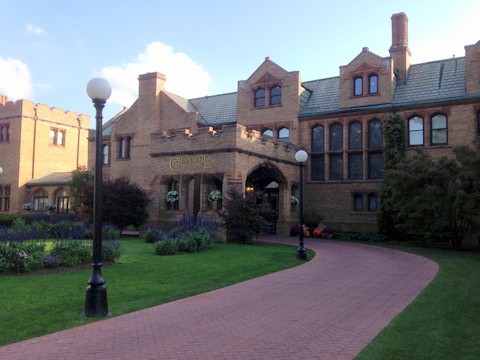
Rather than raze the entire site in Parma, which included the Barilla factory, an adjoining sugar refinery and other 19th-century industrial buildings, he chose to design the complex using the existing brick industrial shells, repurposing them for commercial and cultural use. The site is located to the southeast, just outside, but close to, the historic center.
In addition to the hotel, the “Barilla Center” now includes La Galleria, a small open-air shopping mall with a supermarket, eateries, and shops; a multiplex cinema; the Niccolò Pagnani concert auditorium; and Academia Barilla, a culinary education and training center.

The Parma Ham Consortium (Consorzio del Prosciutto di Parma) is headquartered in the yellow building adjacent to the Barilla Center, directly across from the hotel. A wealthy family of cheese merchants owned the Italian Art Nouveau Villa Magnani in the 19th century.

It’s worthwhile to walk around the corner from the hotel to see the beautiful Villa Barilla, a Liberty-style villa at Viale Veneto 1. Some speculate that the Barilla family may have once lived in this private residence, which dates back to circa 1911.

Inside The Hotel
Grand Hotel de la Ville opened in November 2003. The hotel has 110 rooms, including 3 suites and 4 junior suites, a restaurant (Il Parmigianino, named after a Renaissance painter), bar, fitness center and conference facilities.
Once operated by Sofitel/Accor, it is now independently owned and operated. It is one of the few hotels in the town that can accommodate large groups, so it is a mecca for bus tours, corporate meetings and such.
The rooms are simply furnished in a minimalist style and use hypoallergenic materials. We stayed in Room 109, a Standard room on the first floor that felt small.
It had a comfortable king-size bed, often hard to find in Italian hotels. But the decor was underwhelming: battleship-gray furnishings and matching drapes that felt a little dreary. If we’d known beforehand, we would have booked an upgraded room.

Although perfectly functional, the marbled bathroom was also quite small, with a single sink and tub-shower combination.

Service was outstanding throughout our six-night stay. The multilingual staff at the reception/concierge desk were always helpful with taxis and information, and a porter was always available when needed.
The room was very clean, and housekeeping was excellent. Wi-Fi was free but unstable, constantly cutting in and out.
The breakfast room was windowed and airy. A buffet breakfast was included in the room price and featured hot food, cured meats and cheese, fruits, yogurts, excellent pastries, and more.

By the second day, the server remembered that I wanted a cappuccino normale and my husband a decaffeinato. The pastries were as good as those in France.
Bottom Line
One reason we chose the hotel was its unique architectural history as part of the Renzo Piano redevelopment. That did not disappoint.
Although Grand Hotel de la Ville has a five-star rating, our room was small, felt confining, and lacked the amenities you’d normally expect in an upscale room.
For example, there were no drinking glasses (only paper cups), no soap dish, no complimentary water, limited storage space, an insufficient number of wall outlets, and only one trash can (in the bathroom). You couldn’t use the shaving mirror because it was too far from your face, and water consistently splashed out of the sink.
On the other hand, hotel rates were relatively low compared to five-star properties in New York, Milan or other large cities..
Another positive: Grand Hotel de La Villa is conveniently located. It’s a 10-15 minute walk from Parma’s busy historic center along the Via Emilia, the old Roman road lined with shops. Gelaterias and local restaurants are close by. One great advantage for those arriving by car is that the hotel is outside the city’s pedestrian-only zone and offers parking.
You may want to read my post, Hotels in Italy: What to Expect. Perhaps one lesson learned from this experience: While in Italy, if you can afford to upgrade from a standard guest room, it may be more to your liking.
IF YOU GO
Save to Pinterest!!